
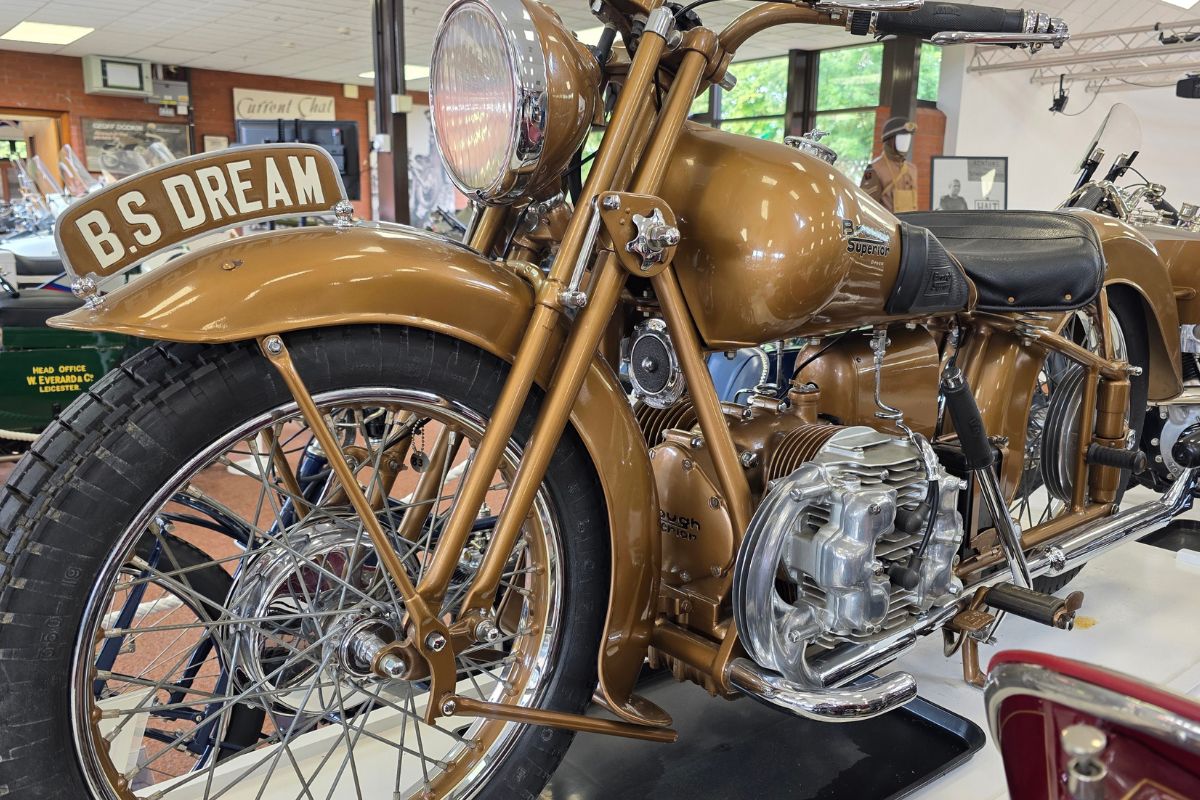
There are few motorcycles in the National Motorcycle Museum that attract as much attention as the Brough Superior Golden Dream.
It is striking to look at, technically fascinating – and it has a story that is almost as remarkable as the machine itself.
Today, it is one of the most valuable motorcycles in the Museum’s collection. But perhaps the most interesting thing about the Golden Dream is that it was never actually put into production.
George Brough’s Golden Dream
George Brough had already established the Brough Superior name as a symbol of quality and performance. His ambition, however, was to go one step further and create an engine of his own.
Until this point, like many motorcycle manufacturers, Brough Superior had relied on proprietary engines from companies such as JAP and Matchless. But in the late 1930s, George Brough decided it was time to build something entirely new.
The result was the Golden Dream.
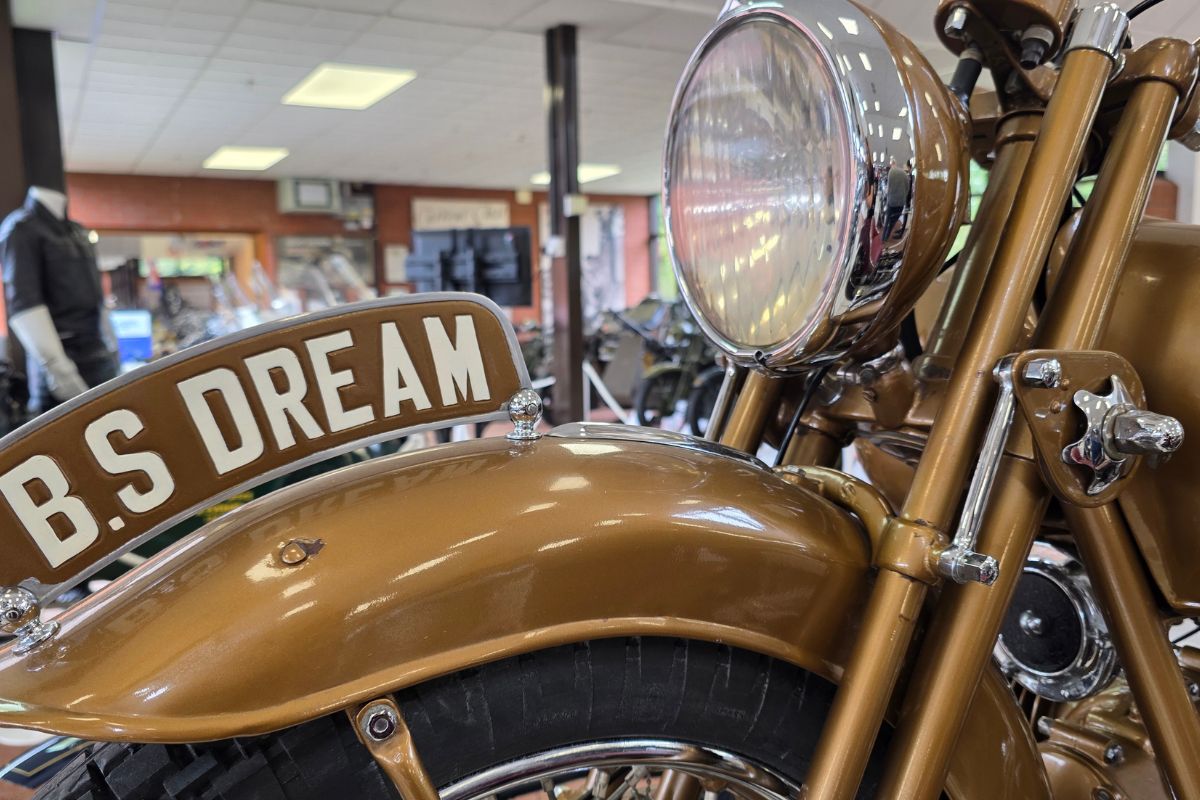
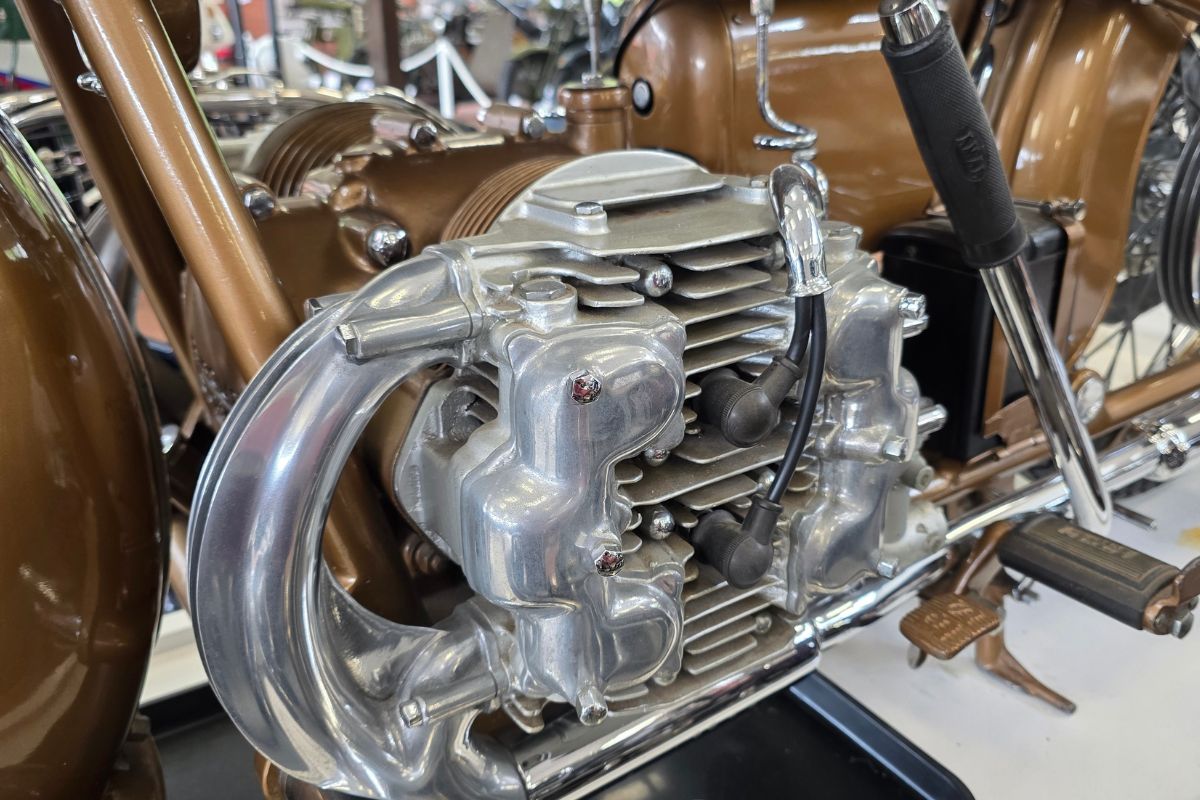
Designed principally by H.J. Hatch, the new motorcycle featured an extraordinary 1,000cc four-cylinder engine. Rather than following the more familiar V-twin layout, the engine consisted of two horizontally opposed flat twins, mounted one above the other and connected by geared crankshafts – giving the engine an appearance rather like an H turned on its side.
It was an incredibly innovative design for its time.
Flat-four engines remain relatively unusual in motorcycles today, although the configuration has been used successfully by manufacturers such as Porsche and Subaru in cars.
The engine featured overhead valves operated by pushrods from twin chain-driven camshafts, while the four-speed foot-change gearbox was built into the engine unit. Final drive was by shaft, with a specially made Lucas Magdyno and distributor mounted on top of the gearbox.
This was not simply a new motorcycle. It was George Brough’s vision of what the next generation of British motorcycles could be.
A motorcycle fit for a house
The Golden Dream was first exhibited at the Earls Court Motorcycle Show in 1938, including a four-speed version built specifically for that year’s show.
It was an expensive machine – extraordinarily so.
At the time, the price of the Golden Dream was comparable to that of a good semi-detached house. In today’s terms, you could think of it as the motorcycle equivalent of buying an Aston Martin or Ferrari.
George Brough intended the motorcycle to go into production following its successful appearance at Earls Court, and two prototypes were produced.
But history had other plans.
Then came war
In 1939, Britain went to war.
Brough Superior turned its attention to war production and engineering work, and the Golden Dream project was abandoned before the motorcycle could enter full production.
The Golden Dream became a glimpse of a motorcycle that might have been.
Of the two prototypes, one eventually found its way into the National Motorcycle Museum collection.
But by the time it arrived, it was far from the immaculate machine visitors see today.
A remarkable discovery inside the engine
Museum restorer Colin Wall was tasked with collecting the motorcycle from the former Brough Superior works on Haydn Road in Nottingham.
It had been sitting there since 1939 and was in a very poor state. It needed extensive restoration before it could take its place in the Museum.
Then Colin discovered something extraordinary.
When he began dismantling the engine, he found that although drawings for the engine had been produced, the prototype engine itself had never been completed.
There was no piston inside the cylinder.
But there was something else.
Inside the engine was a neatly folded copy of the Nottingham Evening Post, dated September 1939. Its headline reported that Hitler had gone to war.
And someone had written a single word across the headline:
“Bollocks.”
Who wrote it, and why, is something we will probably never know.
Perhaps the fitter had just been called up for military service. Perhaps they were frustrated that the Golden Dream was never going to make it into production. Or perhaps it was simply their reaction to the terrible events unfolding around them.
Whatever the reason, the newspaper remained hidden inside the motorcycle for decades.
It is a tiny piece of human history, preserved inside one of Britain’s most ambitious motorcycles.
The dream that survived
The Golden Dream represents much more than an exceptionally rare Brough Superior.
It captures a moment when George Brough was attempting to push British motorcycle engineering in a completely new direction. The motorcycle was ambitious, innovative and extraordinarily expensive – yet the outbreak of war meant that its potential was never realised.
Today, visitors to the National Motorcycle Museum can see one of those original prototypes for themselves.
It is a reminder of what might have been – and, hidden inside its engine, a small and very human reminder of the world in which that dream came to an abrupt end.
Come and see the Brough Superior Golden Dream for yourself at the National Motorcycle Museum.


 Coventry Road
Comments are closed.