
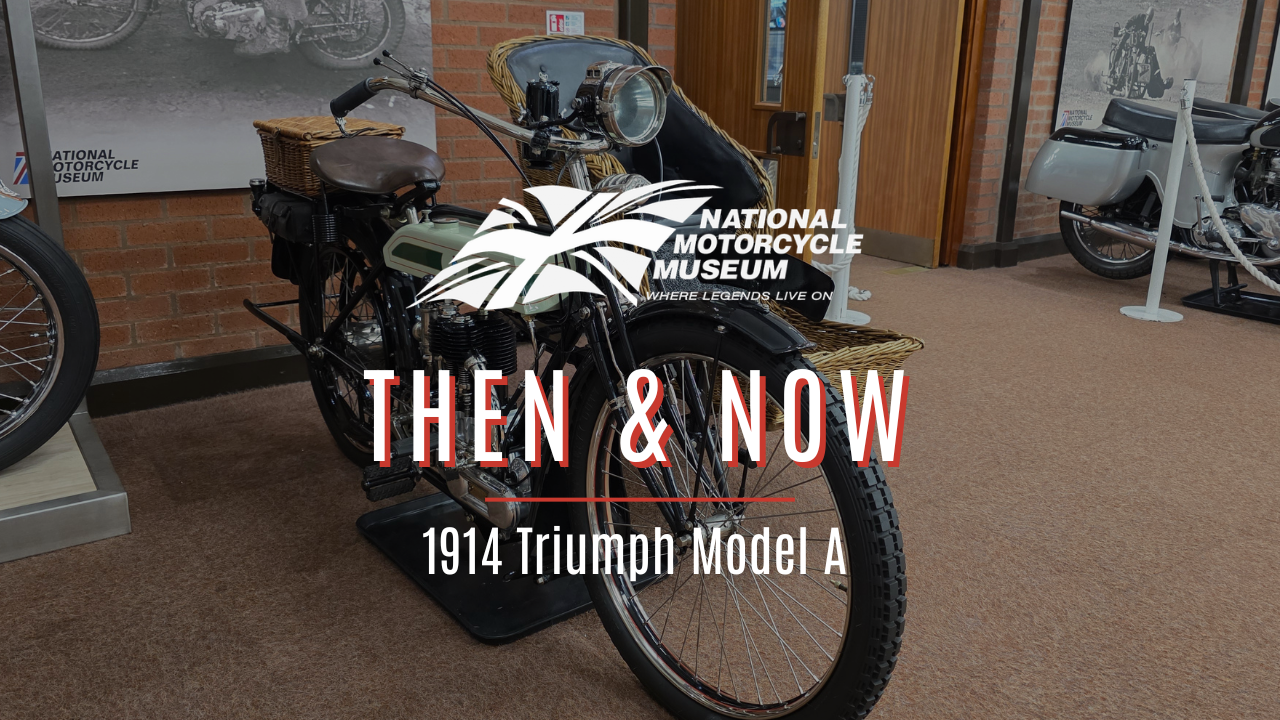
Our first Then & Now feature pairs rare archive footage with one of the National Motorcycle Museum’s most significant exhibits, the 1914 Triumph Model A.
The footage captures brand-new Triumph motorcycles leaving the Triumph Works factory before being put through their paces in military trials. You’ll see them tackling water, rough ground and demonstrating their capability at the outbreak of the First World War, before the film reveals the very motorcycle that has survived to the present day.
The Beginning of Military Motorcycling
At the outbreak of the First World War in 1914, the British Government needed a faster and more reliable way to communicate with troops on the front line. Traditional horse-mounted messengers were increasingly replaced by despatch riders on motorcycles, and several manufacturers submitted machines for military evaluation.
Among them was the Triumph Model A.
Powered by a 499cc air-cooled, four-stroke, single-cylinder engine, the Model A drove its rear wheel by belt and was supplied as a “single speeder”. Buyers could also specify an optional rear hub clutch, known as the “free engine” model.
While robust and dependable, the lack of a gearbox quickly became a limitation for military use. Triumph responded by introducing the larger 550cc Model H, fitted with a Sturmey-Archer three-speed countershaft hand-change gearbox. This improvement made the motorcycle far better suited to the demands of wartime service.
Becoming “The Trusty”
Triumph had been using the advertising slogan “Trusty Triumph” since 1910, but it was the Model H that truly earned the nickname “The Trusty.”
Its reliability in some of the harshest conditions imaginable made it a favourite with military despatch riders. However, even these dependable machines had their weaknesses. The front fork spring on both the Model A and Model H was known to break over rough ground, so riders often strapped a leather belt around the spring as a precaution—a simple field modification that became a familiar sight during the war.
By the end of the First World War in 1918, more than 30,000 Triumph Models A and H had been produced for military service. Production of the successful Model H continued until 1923, by which time an impressive 57,000 motorcycles had been built.
A Rare Survivor
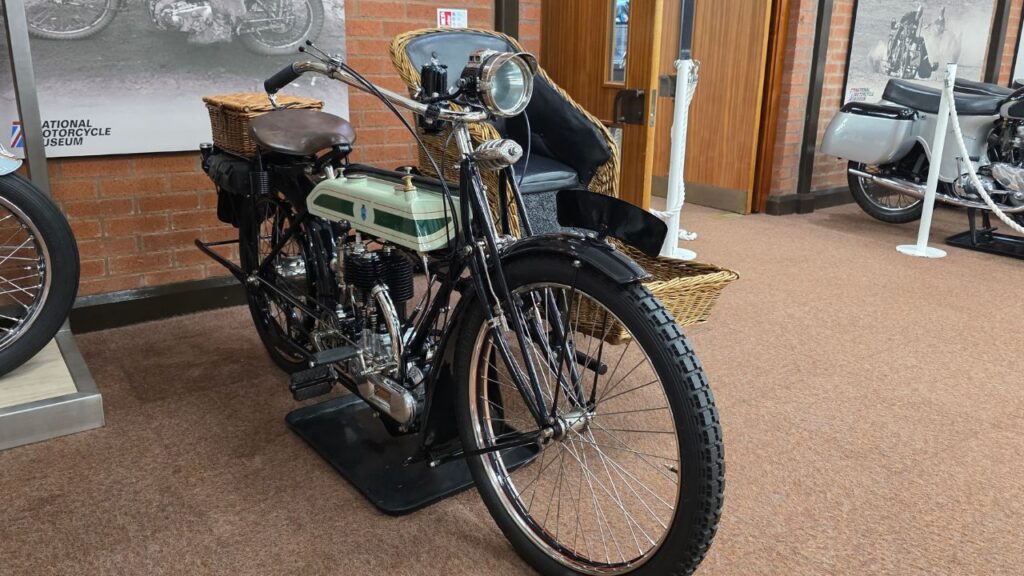
The 1914 Triumph Model A in the National Motorcycle Museum collection is an exceptionally rare survivor from this important period in British history.
Even more significant is the fact that it is fitted with its original wicker sidecar, supplied by Triumph as an option for the War Department. Rather than delivering military motorcycles in camouflage, Triumph supplied them in civilian paint schemes, allowing them to be repainted as required once they entered service.
Standing beside the motorcycle today, it’s hard not to imagine it in the very scenes captured in the archive footage—leaving the factory gates, tackling muddy test courses, and preparing for the vital role it would play during the First World War.
Then & Now
This is the first in our new Then & Now series, where we’ll delve into our archives to reconnect historic film with the motorcycles that still exist today.
The National Motorcycle Museum is home to hundreds of machines, each with its own story waiting to be told. Through rare archive footage, historic photography and the motorcycles themselves, we’ll be bringing those stories back to life—showing not only where these incredible machines came from, but where they are today.
If you’ve enjoyed this journey back to 1914, let us know which motorcycle you’d like us to feature next.


 Coventry Road
Comments are closed.